After a year and a half away from releasing music, Irish singer-songwriter Paddy Keyes returns with a fresh perspective and a renewed sense of direction. From the more synth-heavy sound of "12:15" to the more personal themes running through his upcoming new music, Paddy is figuring out who he wants to be as an artist – and finding the answer might lead him back home to Sligo.
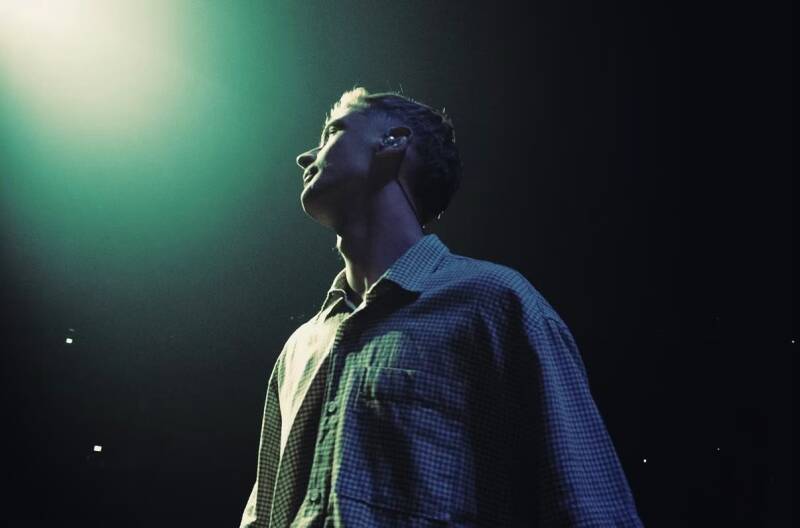
Photo Credits: @theratt_gorman
In a pub, Paddy Keyes reckons you’d find him pretty easily. "A tall guy who loves Guinness, loves music and loves chatting shite - that would be me in a pub setting anyways. I'd say we sing songs as well, you never know. That's only after a couple of Guinness though." Fair enough. It’s an introduction that feels fitting and beautifully down to earth.
But while he might be happy to spend an evening singing around a table in a pub, finding his voice as a songwriter has required a different kind of patience. After spending about a year and a half away from releasing music, he’s returned with a clearer sense of direction. His previous project Over & Over was a period of constant movement. "When I released ‘Over & Over’, the first single, the other four songs weren't even ready yet, and I hadn't planned any content around it. I didn't really understand branding or how important it was for an artist. I was just constantly pushing, pushing, pushing."
Although he's proud of the music that came out of that period, the experience eventually became overwhelming. “It eventually became very stressful. There were points when I was asking myself, What am I doing? Is this for me?”, he recalls. With new management came a different approach. Rather than immediately working towards another release, Paddy Keyes took time to write without a deadline hanging over him. He spent time in Sligo, Dublin and London, allowing songs to develop naturally and giving himself permission to explore subjects beyond romantic relationships.
"I feel like I could have put a lot more time and effort into the branding and into developing myself as an artist."
For the release of “12:15”, he even deleted his Instagram content, embracing the opportunity for a fresh start. After a year and a half away from releasing music, returning felt particularly special. For a smaller artist, taking that much time away can be daunting, and Paddy is conscious of the people who continued to listen while he was gone. “A year and a half is a long time, and while artists like Harry Styles can afford to take that kind of break, it's different as a smaller artist. I was really grateful that people stuck by us and are still listening.”
The pause has also taught him that there's no single formula for releasing music. While he admires the immediacy of artists who can write a song, share it on TikTok and have it on Spotify within a week, he's learned that his own process requires a little more preparation. “I've just learned that I'm not like that. I need time to get my ducks in a row and make sure everything is in place before releasing something.”
“12:15” was the natural starting point for this new chapter. More synth-heavy than much of his previous material, the track moves away from the guitar-driven sound listeners might associate with Paddy, offering a glimpse of the direction he's been exploring during his time away. Its beginnings were rather less dramatic than the idea of a comeback might suggest. During a period of writer's block, Paddy and his manager made a deal: if he failed to write at least one song a week, he'd owe his manager 20€. “At the time, 20 quid was a lot of money – it still is!” he laughs. "So, I was sending him a song or two every week to make sure I kept my money."
"I don't think you can write a song without living your life."
Perhaps the most significant change in Paddy's writing has less to do with instruments and arrangements than with the subjects he's willing to explore. Turning 25 brought a new awareness of how much his life had changed since he first began writing songs. “I remember my 25th birthday. When the clock hit midnight and I turned 25, it was the first time I thought, Oh shit’s getting real now.”
Heartbreak remains part of his songwriting, and “12:15” is still a love song at its core. But the time away has given him the space to look beyond romantic relationships and draw from a wider range of experiences, including bad habits and grief. “When you're 17, it's easy to write about heartbreak because that's what you're experiencing,” he says. “As you get older, you gain a bit more life experience. I don't think you can write a song without living your life, do you know what I mean? You can't keep yourself in a bubble.”
It's a straightforward observation, but one that speaks to the growth running through this new chapter. Rather than trying to force himself into a particular version of an artist, Paddy has allowed his writing to develop alongside him. Stepping outside his comfort zone in everyday life has opened up new possibilities in the studio, too.
"If 18-year-old Paddy listened to it, his first reaction would probably be, "For fuck's sake, are we still here?""
That willingness to confront more complicated feelings is particularly apparent when he reflects on “Relapse”. Asked what his 18-year-old self might think of the song, his initial response is characteristically blunt. “He'd probably think, not again.” He imagines his younger self listening and asking, For fuck's sake, are we still here?” But there's a tenderness beneath the humour. “I'd talk to him and say, 'Listen, we're in a really good place to be able to write this song. We're very lucky with the people we've met, so don't stress. The next while is going to be good. We also wrote 12:15, which is pretty cool.' If he listened to all my music, I think he'd eventually say, 'Okay, that's actually pretty cool.'”
It's a different perspective on revisiting familiar emotions: not necessarily an indication that nothing has changed, but an acknowledgement that some experiences take time to understand. Being able to turn them into music is something to be grateful for, rather than something to be ashamed of.

Photo Credits: @theratt_gorman
For all the changes taking place in his music, one thing seems to be becoming increasingly clear: Paddy is finding his way back home. Sligo has always been part of his story, but his relationship with the place has changed over time. At 17 or 18, he remembers feeling some resentment towards his hometown, eager to leave and see what else was out there. Now, after spending time in Dublin and elsewhere, he finds himself looking forward to returning. “I'm very proud to be from Sligo, but back then, I couldn't wait to get out. And now when I’m in Dublin I'm looking forward to coming home.”
That connection has become an increasingly important part of his songwriting and his sense of identity. While Ireland's music scene continues to gain international attention across genres, from rock and traditional music to alternative and rap, Paddy is particularly interested in the differences between the places that make up the country. “Ireland might be one island, but it's incredibly diverse,” he says. “There's a richness wherever you go, but the music coming out of Sligo will naturally be different from what's coming out of Dublin.”
He sees the country's musical heritage as something to draw from rather than something to imitate. For the new music, he brought a traditional musician into the studio, experimenting with different instruments to find ways of incorporating Irish influences into his sound without leaning on stereotypes. “We were experimenting with different instruments and figuring out how to bring that Irishness into my sound without simply saying, ‘I'm Irish,’ or leaning into some stereotypical Paddy Irishman image.” Being Irish is an important part of his identity, yet the challenge is finding ways to express that identity through the music itself.
"I'm not sure if it's different for women, but Irish men, in particular, can keep a lot of things to themselves. I've found it much easier to put those feelings into my songwriting."
There's also an emotional dimension to that connection. Paddy believes that Irish men, in particular, can struggle to talk openly about their feelings, often convincing themselves that nobody wants to hear what they're going through. Songwriting has offered him a way to work through those emotions, but he hopes the music can encourage others to do the same. “You can convince yourself that nobody wants to hear what you're going through, but people do want to listen.” For an artist whose writing is becoming more personal, that willingness to be open feels particularly significant. The music can be a place to work through difficult experiences, but it can also be a way of making those experiences feel a little less isolating.
Paddy's recent experience playing seven shows at Dublin's 3Arena as support for Westlife offered a reminder of just how far music can take you, even when you're still figuring things out. Initially booked for three shows, the run grew to five and eventually seven. What might have been an overwhelming experience turned out to be surprisingly surreal, largely because there was barely any time to process it. “It's a dream to play even one night at the 3Arena. Initially, we were only booked for three shows, which was already a lot, and then it went up to five and eventually seven. It was mental!”
Technical difficulties meant the band only managed line checks during the first few nights, leaving little opportunity to take in the empty arena before the crowds arrived. Paddy admits that he wasn't particularly nervous at first. It was only halfway through the set that the enormity of the situation began to register. “Halfway through the set, I thought, Oh shit, we're playing the 3Arena! I looked at Millie, my bass player, and she could see it in my eyes.”
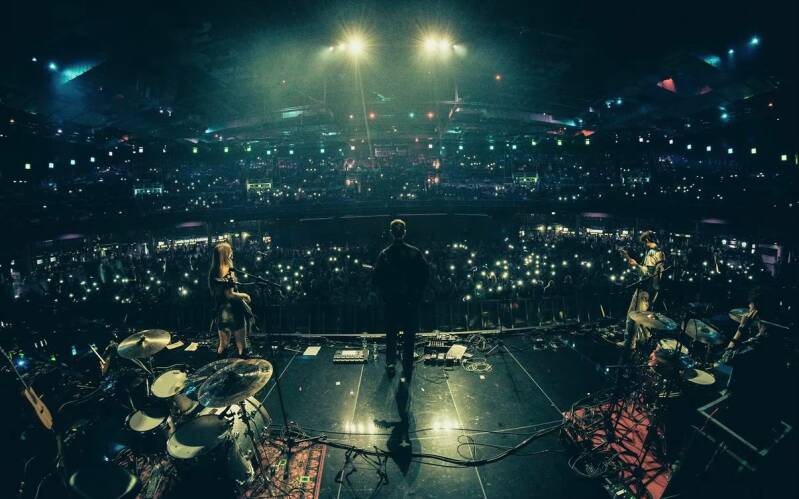
Photo Credits: @theratt_gorman
By the seventh night, the experience had begun to feel almost routine. Still, playing his own music to such a huge audience was a dream come true, made all the more memorable by the kindness of Westlife, who were waiting side-stage and watching the performance. The shows also gave him a different perspective on performing. While a headline gig can bring the pressure of promoting the show and worrying about whether people will turn up, a support slot allows him to focus on putting on a good performance and winning over an audience.
There's something freeing about playing to a crowd so large that individual faces disappear into the distance. In a smaller venue like Whelan's, the intimacy can make every reaction feel more immediate. At the 3Arena, Paddy found himself more comfortable simply letting go. “When you can't really make anyone out, you can just scream, shout and holler as much as you want! I definitely felt more confident on that big stage.” And while he loved the experience, there's one thing he'd like to do next: play the arena under his own name, with an audience there specifically to see him.
For now, the focus is on new music and the possibility of an album, which Paddy sees as the next major step in his career. He's also looking forward to playing Vicar Street for the first time, supporting Aslan, alongside a run of headline shows scheduled for February.
After spending so long figuring out what he wants his music to say, there's a sense that this next chapter is less about rushing towards the next milestone and more about building something that feels right. The year away has given Paddy room to experiment, to revisit familiar emotions from a different perspective and to reconnect with the place that has shaped him. He's still writing love songs, still working through heartbreak, and still the tall guy who'd probably be found with a Guinness in his hand. But he's also making space for the parts of himself that don't fit neatly into a single song or story. For an artist returning with a fresh perspective, that feels like a pretty good place to start.
LISTEN
WORDS BY
Marie Müller, 2026.
READ NEXT
In Conversation With: Paddy Keyes
After a year and a half away from releasing music, Irish singer-songwriter Paddy Keyes returns with a fresh perspective and a renewed sense of direction. From the more synth-heavy sound of "12:15" to the more personal themes running through his upcoming new music, Paddy is figuring out who he wants to be as an artist – and finding the answer might lead him back home to Sligo.
In Conversation With: Alaina May
For Alaina May, songwriting begins with words. Based in Brooklyn, New York, the artist describes herself as a lyrics-first writer, drawn to the process of playing around with phrases, themes and stories until they become something listeners can recognise themselves in.
In Conversation With: Talllon
Some songs have a way of taking you back to a time you didn’t realise you missed until it was gone. For Galway four-piece Talllon, that feeling sits at the heart of their single ‘Go Back Again’, a track built around fading friendships, childhood memories, and the universal longing for simpler times.
In Conversation With: Roadshow
From Kingston’s local circuit to their debut EP, ROADSHOW are making music out of loneliness, uncertainty and the strange emotional terrain of growing up.
In Conversation With: Sunstinger
For Sunstinger, beauty and misery are not opposites. They exist side by side – in the places they call home, in the experience of feeling trapped, and in the noise they make together.
In Conversation With: Louie Cameron
Some milestones make more sense in hindsight.